How AI Platforms Drive Results and Offer Seamless Quality Testing
In the dynamic world of software development, quality assurance testing stands as a guardian, ensuring digital products meet the highest standards before they r
In the dynamic world of software development, quality assurance testing stands as a guardian, ensuring digital products meet the highest standards before they r
In the dynamic world of software development, quality assurance testing stands as a guardian, ensuring digital products meet the highest standards before they reach the hands of users.
However, the traditional methods of testing, while effective, are grappling with the ever-evolving complexity of software and the need for speed. Enter AI platforms, the disruptive force that is reshaping quality testing. This article serves as your compass, guiding you through the advantages AI brings in the world of quality assurance. Brace yourself as we unravel the limitations, benefits, and future of quality testing with AI platforms.
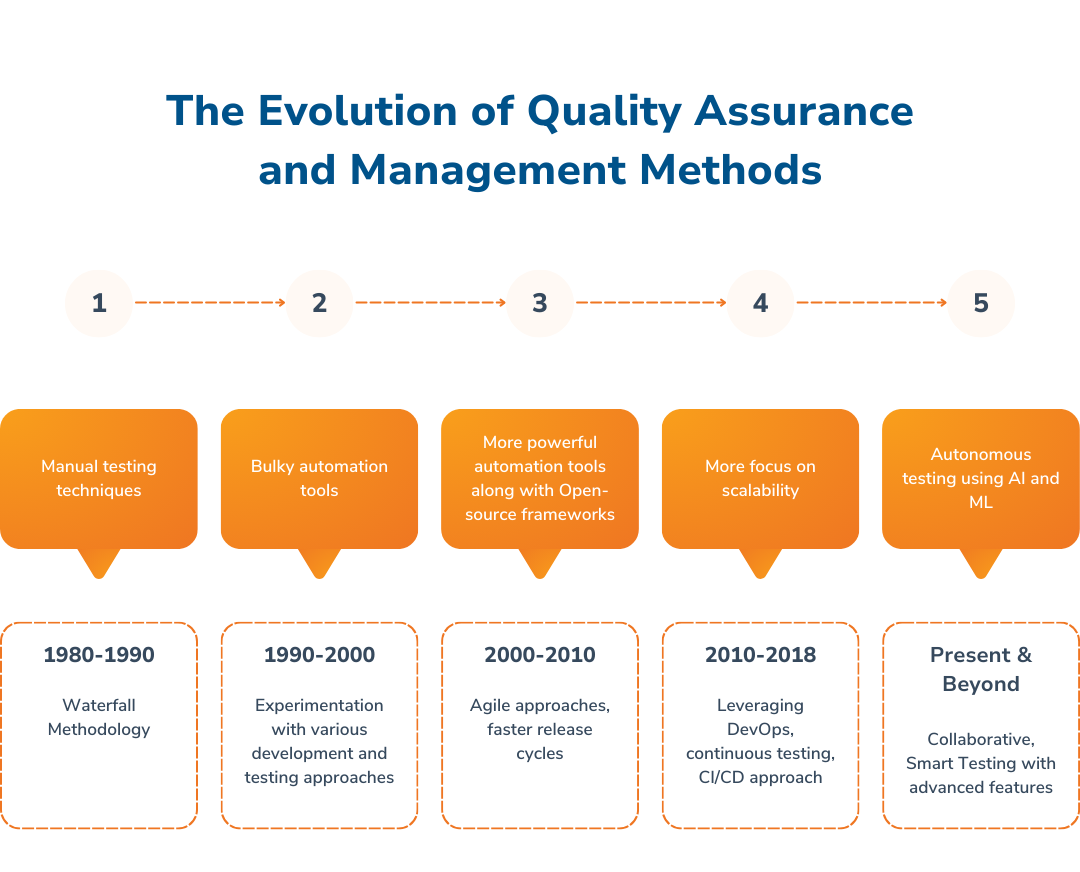
Manual Testing vs AI Testing
Time and Cost
Manual Testing is time-consuming and expensive. While Artificial Intelligence Testing saves time and money, leading to faster delivery.
Tester Presence
Manual Testing requires the presence of a software tester. And Artificial Intelligence Testing requires steady testing with minimal human intervention.
Productivity
Manual Testing has low productivity but Artificial Intelligence Testing has high productivity with automated tools.
Accuracy
Manual Testing is not always 100% accurate, prone to errors. But AI tools ensure accurate test execution, provide detailed results and feedback.
Glitch Identification
Manual Testing may not recognize some glitches but Artificial Intelligence Testing increases the scope of tests, enhancing software quality.
Test Case Creation
Manual Testing is manual, linear process, challenging for large test cases. But Artificial Intelligence Testing's AI bots quickly generate code for numerous test cases.
Manual testing or automated testing: Which One Win?
Among quality assurance methods, a comparison between manual and artificial intelligence (AI) testing reveals distinct advantages and trade-offs.
When looking at Manual testing vs AI testing:
Manual Testing
- Manual testing QA, while valuable, can be time-consuming and costly.
- It necessitates the physical presence of a software tester, potentially resulting in low productivity.
- Accuracy can be compromised due to human error, and certain glitches may go unnoticed.
AI Testing
- On the other hand, AI testing is good for automated quality assurance.
- It streamlines the process, saving both time and money.
- It can operate steadily with minimal human intervention, leading to high productivity.
- AI-powered testing tools excel in accuracy, executing tests precisely each time and providing detailed results and feedback. Moreover, they expand the scope of tests, contributing to overall software quality.
The choice between manual and AI testing hinges on your specific project requirements and goals. Both methods have their merits, and selecting the right one can significantly impact the effectiveness of your testing process.
The Upside of Using AI in QA and Testing
Artificial Intelligence (AI) is no longer a futuristic concept. It's a game-changer, especially in the space of Quality Assurance in software testing. How AI-driven quality assurance is the future? Let’s check it out!
1. Lightning-Fast Timelines
Picture this: the traditional testing process involves testers sifting through thousands of lines of code, looking for that elusive bug. It's time-consuming and, let's face it, exhausting. Enter AI.
- AI-powered testing tools can scan through log files, analyze code, and spot errors in mere seconds.
- But that's not all. AI doesn't suffer from burnout; it consistently delivers accurate results.
- What's more, AI platforms in quality testing can evolve with code changes.
- It adapts, identifies new functions, and can even distinguish between a new feature and a bug arising from code alterations. Talk about efficiency!
2. Well-Researched Build Releases

- AI in software testing doesn't just test; it learns and strategizes.
- AI development companies can analyze successful apps and software in the market to understand what makes them tick.
- Armed with this knowledge, they create new test cases to ensure your app or software doesn't stumble when it comes to achieving its goals.
- It's like having a crystal ball for your QA process.
3. Effortless Test Planning
- Planning test case scenarios can be a laborious task for QA experts.
- Imagine having to repeat the same process every time a new version hits the market. It's a cycle that never ends.
- AI platforms in quality testing and QA automation tools change the game.
- They crawl through every screen, generating and executing test case scenarios effortlessly, saving precious planning time.
4. Expanding the Tester's Toolkit
- AI's entry into QA introduces an exciting shift in roles.
- QA testers find themselves on a learning spree, acquiring skills in neuro-linguistic programming, business intelligence, math optimization, and algorithmic analysis.
- It's not just testing; it's a journey of professional growth.
5. Predictive Analysis

- When looking at AI adoption in quality testing, we deal with AI automation in QA.
- However, it isn't just about testing; it's about understanding users.
- AI can analyze existing customer data to predict how user needs and browsing patterns evolve.
- This foresight allows testers, designers, and developers to stay ahead of user expectations, delivering top-notch quality support.
- With Machine Learning (ML), the AI platform evolves with analyzed user behavior, providing increasingly accurate predictions.