The Ultimate Guide to Agile Testing for Modern Software Teams: Part 1
Here's an interesting observation: Fortune 500 companies prefer Agile! Agile methodologies are 50% more effective than traditional Waterfall and Iterative appro
Here's an interesting observation: Fortune 500 companies prefer Agile! Agile methodologies are 50% more effective than traditional Waterfall and Iterative appro
Here's an interesting observation: Fortune 500 companies prefer Agile! Agile methodologies are 50% more effective than traditional Waterfall and Iterative approaches. The agile approach has helped 60% of businesses boost their revenue and profits. If it isn’t agile, next-gen businesses aren’t paying attention and can you blame them? In Part 1 of this blog on “The Ultimate Guide to Agile Testing for Modern Software Teams”, we will explore why agile methodologies are soon becoming a primary approach for next-gen businesses and everything you need to know about Agile Testing for Modern Software Teams!
What to Know About Agile Testing?
Agile development takes a test-first approach, rather than the test-at-the-end approach of traditional development.
- Agile testing and coding are done incrementally and interactively, building up each feature until it provides enough value to release to production.
- The main reasons to do agile testing are to save money and time.
- Agile testing relies on regular feedback from the end user.
- It also addresses a common problem many software teams have, which is building the wrong solution because the team misinterprets a feature and aligns what they're seeing with their development expertise, rather than what the requirement says or what the end user wants.
Let’s look at some agile testing strategies for modern software teams
The Agile Testing Life Cycle
What is an agile life cycle? Unlike the Waterfall methodology, Agile Testing is not sequential--or done after a coding phase--but continuous. Continuous Testing is one of several continuous activities that take place simultaneously on most agile projects, including:
- Continuous Build;
- Continuous Integration (CI);
- Continuous Delivery (CD); and
- Continuous Deployment.
Continuous Build or build automation is the first stage in implementing an agile software delivery pipeline. If your developers are practicing test-driven development (TDD), they'll write unit tests for each piece of code they write, even before the code itself is written. An important part of the agile methodology in testing, TDD helps developers think through the desired behavior of each unit of software they're building, including inputs, outputs, and error conditions. New features implemented by developers are then checked into a central code base before the software build, which compiles the source code into binary code.
The role of continuous integration in agile testing is a practice where members of a software development team use a version control system and integrate their work frequently to the same location, such as a master branch. Each change is built and verified using tests and other verifications to detect any integration errors as quickly as possible. With build automation, the software build happens automatically, using tools such as Makefiles or Ant, rather than when a developer manually invokes the compiler.
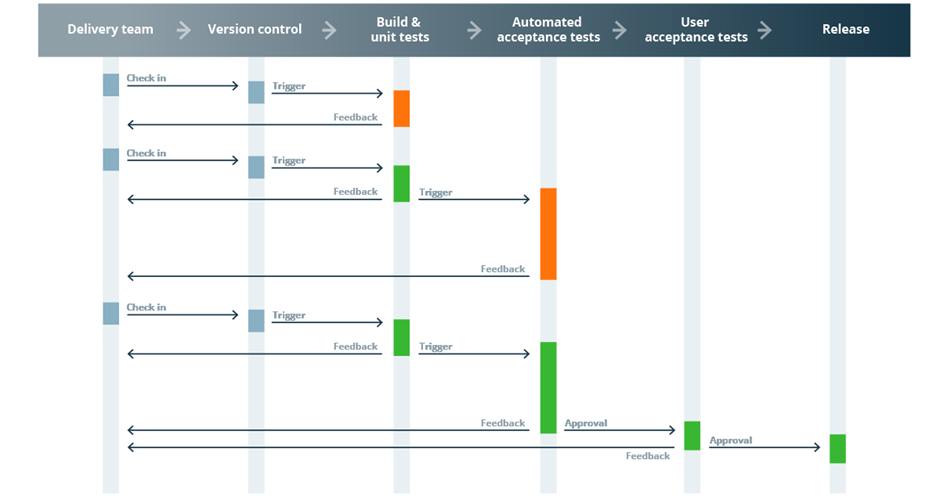
(Agile Testing Lifecycle)
In the last stage of a CI/CD pipeline, once an application passes all the required tests, it's then released into production. For all intents and purposes, this means releasing every good build to users.
Agile Testing Quadrants
Because Agile is an iterative development methodology, testing and coding are done incrementally and interactively, where features can evolve in response to changing customer requirements. Agile testing covers all types of testing, including unit, functional, load, and performance tests. The following Agile Testing Quadrants diagram is a useful model for cross-functional agile development teams to use to plan and execute testing activities.
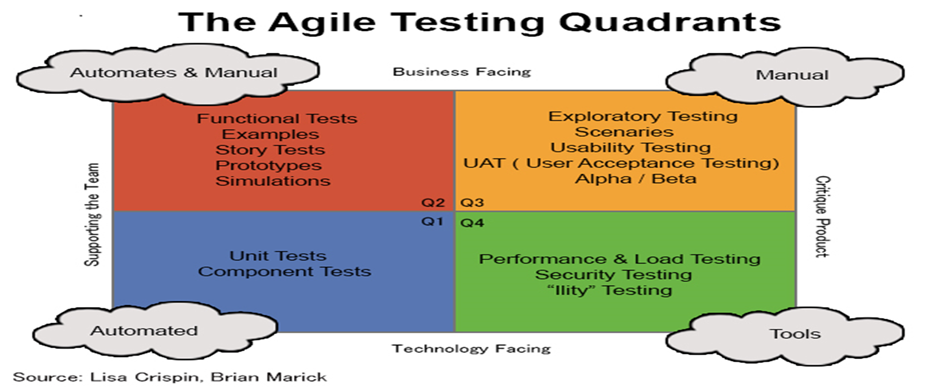
Agile expert Lisa Crispin developed these four Agile testing quadrants as a guide for managers and development teams to use to create test strategies. It's important to realize that the Agile Testing Quadrants diagram is simply a model or taxonomy to help teams plan their testing and that there are no hard and fast rules about which tests belong in which quadrant and in which order the different tests need to be done. (For example, it's not necessary to work through the quadrants from Q1 to Q4 in a Waterfall style.)
Let’s look at the comprehensive guide to agile testing quadrants for QA teams mentioned below:
Quadrant Q1
- These are technology-facing tests that guide development, such as Unit tests, API tests, Web Services testing, and Component Tests that improve product design.
- Tests in Q1 are often associated with automated testing and continuous integration.
Quadrant Q2
- These are business-facing tests that guide development, such as those used for Functional Testing, Story Tests, Prototypes, and Simulations that make sure your software products are properly aligned with the business.
- Tests in Q2 are often associated with both automated and manual testing.
Quadrant Q3
- These are business-facing tests used to evaluate or critique the product.
- Q3 covers tests such as exploratory testing, scenario-based testing, usability testing, user acceptance testing, and alpha/beta testing and can involve product demos designed to get feedback from actual users.
- Tests in Q3 are often associated with manual testing.
Quadrant Q4
- These are technology-facing tests used to evaluate or critique the product.
- Q4 covers test such as performance, load, stress, and scalability tests, security tests, maintainability, memory management, compatibility and interoperability, data migration, infrastructure, and recovery testing.
- These tests are often automated.
The clouds at the quadrant corners signify whether tests in that quadrant generally require automation, manual testing, or specialized tools. The division of tests into quadrants allows teams to strategize whether they have the right skills to accomplish each of the different types of testing, or if they have the necessary hardware, software, data, and test environments. It also makes it easier to customize your agile testing process on a project-by-project or skill-by-skill basis. So, for example, if you don't have a tester on your QA team with appropriate load or performance testing skills, it helps you to see the need to bring in a contractor or outsource that particular test. A testing strategy based on the Agile Testing Quadrants requires effective workgroup communication, which is made easier by a test management solution that allows the team to work collaboratively in real-time.
Agile Methodology in Testing
Let’s look at some of the best practices for continuous delivery in agile frameworks. But first, in traditional waterfall testing and development, software developers typically concern themselves with three types of requirements, often addressed at different stages in a software project:
- Business requirements: These describe why the product is being built and identify the benefits both customers and the business will reap
- User requirements: These describe what tasks or business processes a user will be able to perform with the product
- Functional requirements: These describe the specific system behaviors that must be implemented.
In traditional waterfall development, functional requirements often reside in a software requirements specification (SRS) document, which is used by analysts to communicate detailed requirements information to developers, testers, and other project stakeholders.
User stories
- User stories, a less formal approach, are used in agile development to help shift the focus on software projects from writing about software requirements to talking about them.
- User stories are short, simple descriptions of a feature told from the perspective of the person who wants the new capability, usually a user or customer of the system.
- On agile projects, user stories are the smallest units of work done by a development team and usually follow this standard user-story template:
Example:
As a {type of user}, I want {goal} so that I {receive benefit}.
Here's a simple example from a bank